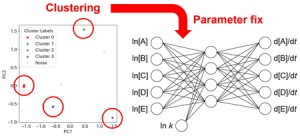
化学反応ニューラルネットワークへのクラスタリング導入による予測精度の向上 [Published online J. Comput. Chem. Jpn., 24, 99-101, by J-STAGE]

[Published online Journal of Computer Chemistry, Japan Vol.24, 99-101, by J-STAGE]
<Title:> 化学反応ニューラルネットワークへのクラスタリング導入による予測精度の向上
<Author(s):> 中島 陸, 塩谷 友希, 嶋田 五百里
<Corresponding author E-Mill:> iori(at)shinshu-u.ac.jp
<Abstract:> Chemical Reaction Neural Network (CRNN) is a method that enables data-driven analysis of reaction mechanisms by embedding the principles of reaction kinetics into the architecture of a neural network. However, conventional CRNN-based methods required large amounts of training data for accurate prediction. In this study, we aim to enhance prediction accuracy by applying a clustering approach to the CRNN results. Reactions that were consistently predicted across multiple randomized initializations were identified, and the corresponding weights were fixed, thereby improving the overall prediction accuracy.
<Keywords:> KeywordsReaction mechanism, Kinetic, Chemical Reaction Neural Network, Data-driven, Clustering
<URL:> https://www.jstage.jst.go.jp/article/jccj/24/3/24_2025-0017/_article/-char/ja/
動的構造サンプリングに基づくNeuropsinの 反応機構解析:MD×QM/MMアプローチ [Published online J. Comput. Chem. Jpn., 25, 26-27, by J-STAGE]

[Published online Journal of Computer Chemistry, Japan Vol.25, 26-27, by J-STAGE]
<Title:> 動的構造サンプリングに基づくNeuropsinの 反応機構解析:MD×QM/MMアプローチ
<Author(s):> 藤原 麻衣, 阿部 光将, 堀岡 洋太, 福西 快文, 田村 英紀, リントゥルオト ユハ, リントゥルオト 正美
<Corresponding author E-Mill:> masami(at)kpu.ac.jp
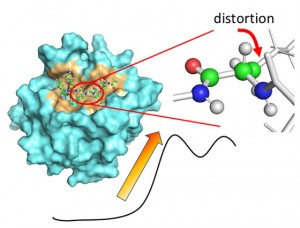
<Abstract:> The enzymatic reaction mechanism of the serine protease neuropsin (KLK8) was investigated using QM/MM calculations combined with MD simulations. The out-of-plane distortion of the scissile amide bond in the substrate-binding complex contributed to a reduction in the activation barrier. Nucleophilic attack by Ser195 Oγ initiated proton transfer among the catalytic triad and the formation of a tetrahedral intermediate. Free energy analysis indicated that this intermediate formation is the rate-determining step, emphasizing the importance of amide bond distortion and oxyanion hole stabilization for catalysis.
<Keywords:> serine protease, neuropsin, KLK8, MD simulation, QM/MM
<URL:> https://www.jstage.jst.go.jp/article/jccj/25/1/25_2025-0028/_article/-char/ja/

FMOプログラムABINIT-MPの整備状況2025 [Published online J. Comput. Chem. Jpn., 25, 7-14, by J-STAGE]

[Published online Journal of Computer Chemistry, Japan Vol.25, 7-14, by J-STAGE]
<Title:> FMOプログラムABINIT-MPの整備状況2025
<Author(s):> 望月 祐志, 中野 達也, 坂倉 耕太, 土居 英男, 奥脇 弘次, 福澤 薫, 加藤 季広, 成瀬 彰, 星野 哲也, 大島 聡史, 滝沢 寛之, 中島 研吾, 片桐 孝洋
<Corresponding author E-Mill:> fullmoon(at)rikkyo.ac.jp
<Abstract:> The next version of ABINIT-MP, Open Version 2 Revision 12, is scheduled for release in spring 2026. We are also planning Revision 16, which will incorporate GPU acceleration for MP2 energy calculations. In parallel, we are preparing the Version 3 series to support open-shell and multireference systems. Furthermore, development has begun on FMO-X, a new implementation designed for GPU environments from the outset. This paper presents an overview of these developments.
<Keywords:> キーワードFragment molecular orbital, FMO, ABINIT-MP, GPU, Python
<URL:> https://www.jstage.jst.go.jp/article/jccj/25/1/25_2026-0001/_article/-char/ja/

Anisotropic Displacement Parameters of Ba2 in Clathrate Structure Ba8Ga16Ge30 from Molecular Dynamics Simulations [Published online J. Comput. Chem. Jpn., 25, 1-6, by J-STAGE]

[Published online Journal of Computer Chemistry, Japan Vol.25, 1-6, by J-STAGE]
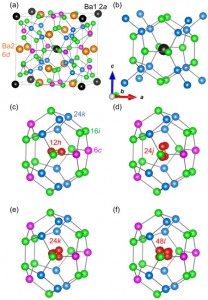
<Title:> Anisotropic Displacement Parameters of Ba2 in Clathrate Structure Ba8Ga16Ge30 from Molecular Dynamics Simulations
<Author(s):> Yoyo HINUMA
<Corresponding author E-Mill:> y.hinuma(at)aist.go.jp
<Abstract:> Atomic displacement parameters (ADPs) are crystallographic structural data that may represent atomic motion, possible static displacive disorder, and thermal vibration. Thermoelectric materials often contain rattling atoms to improve performance, and ADPs describe how atoms rattle. This paper discusses the ADPs of the Ba2 site of Ba8Ga16Ge30, a clathrate structure thermoelectric material. A molecular dynamics simulation approach using a neural network potential was applied to Ba8Ga16Ge30 models considering the disorder of Ga and Ge on the Ga/Ge cage sites. The calculated U is non-zero when extrapolated to 0 K, overestimates experimental U11 by 0.005-0.009 2 at temperatures between 200 and 300 K, and overestimates experimental U22 by 0.010-0.014 2 between 15 and 300 K.
<Keywords:> Atomic displacement parameters, clathrate structure, Ba8Ga16Ge30, molecular dynamics, universal neural network potential
<URL:> https://www.jstage.jst.go.jp/article/jccj/25/1/25_2025-0026/_article/-char/ja/

A Web-Based User Interface for Efficient Construction and Editing of Slab Models for First-Principles Solid-State Calculations [Published online J. Comput. Chem. Jpn., 25, 19-21, by J-STAGE]

[Published online Journal of Computer Chemistry, Japan Vol.25, 19-21, by J-STAGE]
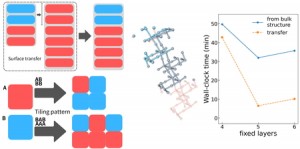
<Title:> A Web-Based User Interface for Efficient Construction and Editing of Slab Models for First-Principles Solid-State Calculations
<Author(s):> Akifumi SEKIHARA, Hidenobu SHIROISHI
<Corresponding author E-Mill:> h-shiroishi(at)tokyo-ct.ac.jp
<Abstract:> Preparing slab models and large supercells for first-principles surface calculations often requires tedious manual editing of atomic coordinates. We developed browser-based tools that provide synchronized coordinate-table editing and interactive 3D visualization (Mol*) for two structure models. The tools implement (i) surface transfer, which copies an optimized surface region from a thin slab to a thicker slab while preserving Cartesian coordinates, (ii) composite-supercell construction based on a user-defined tiling pattern of pre-optimized blocks, and (iii) a Python-based calculator of partial zero-point energies and vibrational enthalpies. The backend is implemented in Python using ASE and pymatgen, and the frontend is built with TypeScript/React.
<Keywords:> Keywords slab model, first-principles calculation, browser-based UI, surface transfer, composite supercell, Quantum ESPRESSO
<URL:> https://www.jstage.jst.go.jp/article/jccj/25/1/25_2026-0006/_article/-char/ja/

非共有結合性相互作用の量子化学的定量評価法Negative Fragmentation Approach の開発 [Published online J. Comput. Chem. Jpn., 25, 15-18, by J-STAGE]

[Published online Journal of Computer Chemistry, Japan Vol.25, 15-18, by J-STAGE]
<Title:> 非共有結合性相互作用の量子化学的定量評価法Negative Fragmentation Approach の開発
<Author(s):> 鷹野 優, 兼松 佑典, 小田 雄一朗, 近藤 寛子, 中村 春木
<Corresponding author E-Mill:> ytakano(at)hiroshima-cu.ac.jp
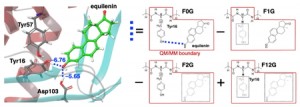
<Abstract:> Noncovalent interactions such as hydrogen bonds and π-π interactions are involved in the stabilization of three-dimensional structures and specific molecular recognition. We have recently developed the Negative Fragmentation Approach (NFA) to evaluate noncovalent interactions quantitatively, using quantum chemical calculations. Although NFA is effective for small and medium-sized systems, its direct application to large macromolecules such as proteins demands further refinement. Here, we extended the original NFA to evaluate noncovalent interactions in proteins by combining it with the ONIOM method. The NFA-ONIOM scheme was applied to a hydrogen bond between 5-3-ketosteroid isomerase and equilenin, an analogue of the intermediate.
<Keywords:> noncovalent interaction, Negative Fragmentation Approach, hydrogen bond, 5-3-ketosteroid isomerase, ONIOM
<URL:> https://www.jstage.jst.go.jp/article/jccj/25/1/25_2026-0003/_article/-char/ja/

Electronic Analysis of Intermolecular Interactions in Hexose Crystals [Published online J. Comput. Chem. Jpn., 25, 22-25, by J-STAGE]

[Published online Journal of Computer Chemistry, Japan Vol.25, 22-25, by J-STAGE]
<Title:> Electronic Analysis of Intermolecular Interactions in Hexose Crystals
<Author(s):> Tomoko TAKASHITA, Ryunosuke TAKATA, Mizuki AOE, Kei TAKESHITA, Tomohiko ISHII
<Corresponding author E-Mill:> s25d154(at)kagawa-u.ac.jp
<Abstract:> Although all hexoses share the molecular formula C6H12O6, differences in hydroxyl group orientation lead to pronounced variations in crystal packing and hydrogen-bond networks. However, a systematic, site-resolved electronic comparison of intermolecular hydrogen bonding across hexose crystals remains limited. To clarify the electronic features of intermolecular hydrogen bonding, we investigated 13 hexoses using DV-Xα molecular orbital calculations on cluster models constructed from single-crystal structures (CSD and in-house determinations). Hydrogen-bond strength was evaluated by the bond overlap population (BOP), and Full Interaction Maps (FIMs) analysis was performed for β-aldohexoses. BOP analysis showed that the anomeric O1 site gives the largest values in β-aldohexoses, whereas no distinct site preference appears in α-aldohexoses; in contrast, O1 shows the smallest values in ketohexoses. Combined BOP and FIMs analyses indicate that both the strength and site selectivity of intermolecular hydrogen bonding are governed by steric features arising from molecular structure. FIMs analysis further demonstrated that hydrogen-bond formation depends not only on electronic strength but also on spatial arrangement. The present findings provide a quantitative, site-resolved basis for understanding monosaccharide crystal structures and support rational design of rare-sugar-based functional materials by linking hydrogen-bond electronics with packing geometry.
<Keywords:> crystal structure, hexoses, molecular orbital calculations, DV-Xα method, intermolecular hydrogen bonding, Full Interaction Maps (FIMs)
<URL:> https://www.jstage.jst.go.jp/article/jccj/25/1/25_2026-0002/_article/-char/ja/

Electronic Structure of Palladium Oxide Calculated Using the DFT+U+V Method [Published online J. Comput. Chem. Jpn. Int. Ed., 12, -, by J-STAGE]

[Published online Journal of Computer Chemistry, Japan -International Edition Vol.12, -, by J-STAGE]
<Title:> Electronic Structure of Palladium Oxide Calculated Using the DFT+U+V Method
<Author(s):> Akihisa ISHIKAWA, Wataru OTA, Tohru SATO
<Corresponding author E-Mill:> tsato(at)scl.kyoto-u.ac.jp
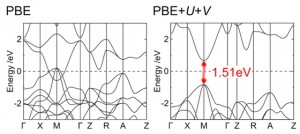
<Abstract:> The electronic structures of tetragonal palladium oxide (PdO, space group P42/mmc) were calculated using the first-principles DFT+U and DFT+U+V methods. The calculations gave the band gap that reproduced the experimental values. It was found that the conduction band comprised the anti-bonding interactions of Pd 4dzx O 2p and Pd 4dzx O 2s, whereas the valence band top mainly comprised the anti-bonding interactions of Pd 4dz2 O 2p and Pd 4dx2-y2 O 2p. The DFT+U+V method, compared with the PBE and HSE06 functionals, gave larger Pd O interactions near the valence band top. The electronic structures of rock salt PdO in the type-II antiferromagnetic phase were also computed as a comparison with nickel oxide (NiO).
<Keywords:> Electron-electron interaction, Density functional theory, Band structure, Density of states, Antiferromagnetism
<URL:> https://www.jstage.jst.go.jp/article/jccjie/12/0/12_2025-0008/_html

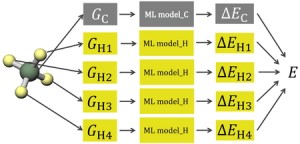
Development of Machine Learning Models to Reproduce Coupled-Cluster Molecular Energies [Published online J. Comput. Chem. Jpn., 24, 95-98, by J-STAGE]

[Published online Journal of Computer Chemistry, Japan Vol.24, 95-98, by J-STAGE]
<Title:> Development of Machine Learning Models to Reproduce Coupled-Cluster Molecular Energies
<Author(s):> Taichi SOMEGO, Yasuhiro IKABATA, Hitoshi GOTO
<Corresponding author E-Mill:> gotoh(at)tut.jp
<Abstract:> We attempted to reproduce molecular energies at the coupled-cluster level from molecular structures by constructing machine learning models that reproduce atomic environment energies, defined as the difference between the atomic energy in a molecule and that of the corresponding isolated atom. To obtain atomic energies from quantum chemical calculations, we adopted energy density analysis. Our results showed that the prediction accuracy of coupled-cluster molecular energies was comparable to that for density functional theory.
<Keywords:> Coupled-cluster method, Molecular energy, Machine learning, Energy density analysis, Atomic environment energy
<URL:> https://www.jstage.jst.go.jp/article/jccj/24/3/24_2025-0014/_article/-char/ja/

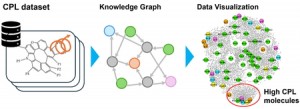
知識グラフに対する力学シミュレーションによるoxaza[7]dehydrohelicene誘導体の円偏光発光特性分析 [Published online J. Comput. Chem. Jpn., 24, 92-94, by J-STAGE]

[Published online Journal of Computer Chemistry, Japan Vol.24, 92-94, by J-STAGE]
<Title:> 知識グラフに対する力学シミュレーションによるoxaza[7]dehydrohelicene誘導体の円偏光発光特性分析
<Author(s):> 菅波 祐介, 藤波 美起登, SALEM Mohamed S. H., 滝澤 忍, 中井 浩巳
<Corresponding author E-Mill:> nakai(at)waseda.jp
<Abstract:> Circularly polarized luminescence (CPL) is the optical property of chiral molecules with promising applications in photonic devices. Oxaza[7]dehydrohelicene derivatives have attracted attention as potential high-performance CPL materials. However, strategies for designing high-performance derivatives remain unclear due to the complexity of excited-state characteristics. A knowledge graph (KG) is a framework that represents data in a graph-based structure and is applied for interpretable reasoning and visualization of relationships within data. In this study, we constructed a KG of oxaza[7]dehydrohelicene derivatives using quantum chemical calculations and conducted mechanics simulations to visualize and analyze the relationship between substituents and CPL properties.
<Keywords:> Circularly polarized luminescence, Knowledge graph, Molecular design, Quantum chemistry, Dissymmetry factor
<URL:> https://www.jstage.jst.go.jp/article/jccj/24/3/24_2025-0018/_article/-char/ja/